

8 Logistics KPIs That Help Reduce Costs and Improve Supply Chain Efficiency
Logistics efficiency is no longer determined solely by the ability to move goods from point A to point B. In today’s increasingly competitive global market, the real competitive advantage lies in the ability to continuously measure, analyse and optimise supply chain performance.
Companies involved in importing and exporting goods face daily challenges such as delays, unexpected costs, stock shortages, customs constraints and fluctuations in demand. In this environment, relying solely on experience is no longer enough to make informed business decisions.
This is where Logistics KPIs (Key Performance Indicators) play a crucial role. They enable businesses to transform data into actionable insights, identify opportunities for improvement and strengthen their competitive position.
In this article, we explore the 8 essential Logistics KPIs, explain why they matter and demonstrate, through practical examples, how they can help reduce costs, improve operational efficiency and enhance customer service.
What Are Logistics KPIs?
Logistics KPIs are performance indicators used to evaluate the efficiency of logistics operations throughout the entire supply chain.
They help measure several critical aspects, including:
- Response times;
- Operational costs;
- Service quality;
- Transport efficiency;
- Warehouse performance;
- Operational sustainability.
More than simply generating reports, these indicators help companies answer essential business questions such as:
- Are deliveries arriving on time?
- What is the actual cost of each shipment?
- Where are the main operational bottlenecks?
- How can we reduce costs without compromising service quality?
Without reliable metrics, it becomes extremely difficult to identify problems, evaluate performance and measure the impact of improvement initiatives.
Why Are Logistics KPIs So Important?
Companies that consistently monitor their Logistics KPIs are able to make faster decisions, minimise waste and continuously improve their operations.
Among the main benefits are:
- Greater operational visibility;
- Lower logistics costs;
- Improved service levels;
- Increased predictability;
- Higher customer satisfaction;
- Better negotiation capacity with logistics partners and carriers;
- More informed strategic decision-making.
Simply put, what gets measured gets improved.
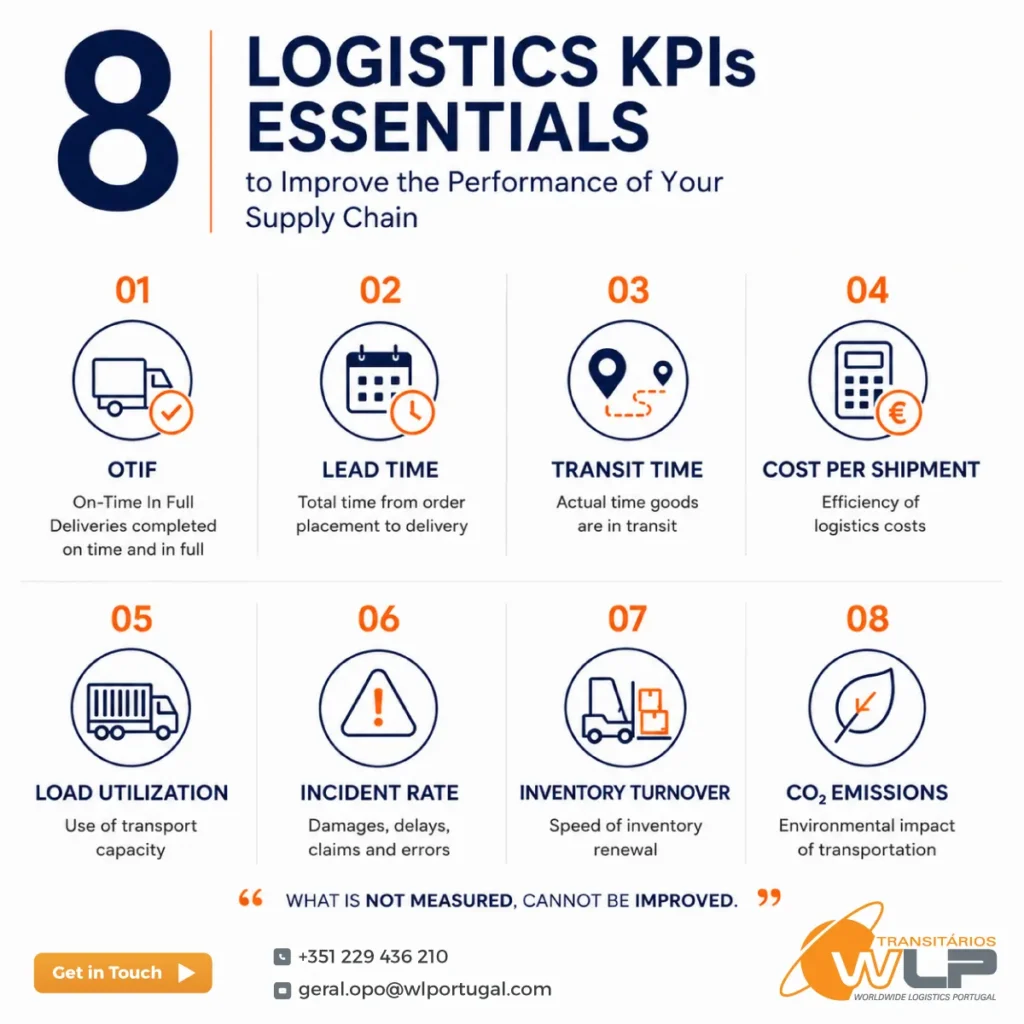
The 8 Essential Logistics KPIs
KPI | What It Measures | Main Benefit |
|---|---|---|
OTIF | Complete and on-time deliveries | Higher customer satisfaction |
Lead Time | Total order-to-delivery time | Faster operations |
Transit Time | Actual transportation time | Better planning |
Cost per Shipment | Average logistics cost per shipment | Cost reduction |
Load Factor | Transport capacity utilisation | Greater efficiency |
Incident Rate | Damage, delays and claims | Higher service quality |
Inventory Turnover | Stock renewal speed | Lower capital tied up in inventory |
CO₂ Emissions | Environmental impact of transport | More sustainable logistics |
1. OTIF (On Time In Full)
OTIF (On Time In Full) measures the percentage of orders delivered on schedule, complete and without errors.
It is considered one of the most important logistics KPIs because it directly reflects customer service quality.
A high OTIF rate translates into greater customer confidence, fewer complaints and stronger long-term business relationships.
Practical Example
An exporting company discovers that only 87% of its shipments are delivered complete and on time.
After analysing the data, it finds that most delays are caused by documentation preparation rather than transportation itself.
By improving internal documentation processes, the company increases its OTIF rate to 96%, significantly reducing customer complaints and improving overall satisfaction.
2. Lead Time
Lead Time represents the total time elapsed between receiving a customer order and delivering the goods.
It includes every stage of the process:
- Order processing;
- Cargo preparation;
- Documentation;
- Customs clearance;
- Transportation;
- Final delivery.
The shorter the Lead Time, the greater the company’s ability to respond quickly to market demands.
Practical Example
A Portuguese manufacturer imports components from Asia.
Although sea transport takes approximately 28 days, the total Lead Time frequently exceeds 40 days.
A detailed analysis reveals that most delays occur during documentation preparation and customs clearance.
By improving coordination between departments and streamlining documentation processes, the company reduces Lead Time by five days without changing its transport mode or increasing logistics costs.
3. Transit Time
Unlike Lead Time, Transit Time measures only the actual transportation time between origin and destination.
This KPI enables companies to compare:
- Different transport modes;
- Alternative routes;
- Logistics providers.
It is particularly useful for identifying recurring delays and improving logistics planning.
Practical Example
A company regularly exporting goods to Northern Europe compares average transit times across different departure ports.
The analysis shows that changing the shipping route reduces Transit Time by two days, allowing faster deliveries while lowering inventory carrying costs.
4. Cost per Shipment
Knowing the average logistics cost of each shipment is essential for evaluating operational profitability.
This KPI may include:
- Transportation;
- Warehousing;
- Insurance;
- Documentation;
- Customs duties;
- Administrative costs.
Monitoring this indicator helps identify optimisation opportunities and negotiate better conditions with logistics partners.
Practical Example
A company notices that its average shipment cost has increased by approximately 12% over the past year.
After analysing the data, it discovers that many orders are being shipped separately due to poor planning.
By consolidating shipments and improving dispatch scheduling, the company significantly reduces its average logistics cost per shipment while maintaining the same service levels.
5. Load Factor
The Load Factor measures how efficiently the available capacity of a truck, container, aircraft or any other transport mode is being utilised.
Whenever a vehicle travels partially empty, the company incurs costs that could have been distributed across a larger volume of goods.
A high Load Factor generally results in:
- Lower transportation cost per unit;
- Improved operational profitability;
- Reduced CO₂ emissions;
- Greater logistics efficiency.
Practical Example
An exporting company used to send two weekly shipments to the same European destination.
After analysing this KPI, it discovered that both shipments had an average load factor of less than 60%.
By consolidating both shipments into a single weekly dispatch, the company increased capacity utilisation to approximately 90%, significantly reduced transport costs and lowered the environmental impact of its operations.
6. Incident Rate
Even in well-managed logistics operations, incidents can occur.
However, monitoring how often they happen allows companies to identify recurring patterns and implement preventive measures.
This KPI may include:
- Damaged goods;
- Lost shipments;
- Returns;
- Delivery delays;
- Documentation errors;
- Customer complaints.
The lower the Incident Rate, the higher the overall quality of the logistics operation.
Practical Example
A company noticed an increase in customer complaints regarding cargo damaged during sea transport.
Following an internal investigation, it identified that the issue originated from inadequate cargo packaging before shipment.
After revising its packaging procedures, the company dramatically reduced incidents while avoiding unnecessary return costs and compensation claims.
7. Inventory Turnover
For businesses that operate warehouses, Inventory Turnover is one of the most important performance indicators.
It measures how quickly inventory is sold and replenished over a given period.
A healthy turnover helps companies:
- Reduce capital tied up in inventory;
- Lower warehousing costs;
- Prevent product obsolescence;
- Improve cash flow;
- Increase product availability.
A very low turnover may indicate excess inventory, while an excessively high turnover can lead to stock shortages and lost sales.
Practical Example
An industrial company discovered that certain components remained in storage for several months without being used.
After reviewing purchasing policies and improving demand forecasting, it significantly reduced average inventory levels without affecting production, releasing working capital for other investments.
8. CO₂ Emissions per Shipment
Sustainability has evolved from being merely an environmental concern into a strategic business priority.
Increasingly, companies are expected to demonstrate the environmental impact of their logistics operations, whether due to customer requirements, ESG commitments or regulatory obligations.
Measuring CO₂ emissions enables organisations to:
- Compare different transport modes;
- Evaluate alternative logistics solutions;
- Reduce their carbon footprint;
- Strengthen their environmental responsibility.
Practical Example
A company that regularly exported goods by air switched to a combination of sea and road transport whenever delivery deadlines allowed.
This decision significantly reduced transport-related CO₂ emissions while maintaining service quality and lowering logistics costs.
The Most Common Mistakes When Managing Logistics KPIs
Although most companies recognise the importance of KPIs, many fail to fully benefit from the information available.
Some of the most common mistakes include:
Measuring Too Many KPIs
Tracking dozens of indicators often makes analysis more complex and distracts attention from what truly matters.
It is far more effective to monitor a smaller number of meaningful KPIs than to produce lengthy reports that generate little value.
Focusing Only on Costs
Reducing logistics costs is important, but it should never come at the expense of service quality.
An apparently cheaper logistics solution may ultimately result in delays, customer complaints and lost business.
Failing to Set Targets
KPIs only become meaningful when clear objectives have been established.
Measuring performance without comparing it against predefined targets limits continuous improvement.
Looking Only at Historical Data
KPIs should support future decision-making.
Knowing what happened is useful, but understanding why it happened—and how to prevent it from happening again—is far more valuable.
Not Involving Logistics Partners
Supply chains depend on multiple stakeholders.
Sharing KPIs and performance objectives with freight forwarders, carriers and logistics partners contributes to continuous improvement across the entire supply chain.
How to Build a Logistics KPI Dashboard
Monitoring KPIs does not require complex reporting systems.
A simple dashboard can include:
- OTIF;
- Average Lead Time;
- Average Transit Time;
- Average Cost per Shipment;
- Incident Rate;
- Average Load Factor;
- Estimated CO₂ Emissions.
Ideally, these indicators should be updated regularly and reviewed jointly by logistics, operations and management teams.
The objective is not to generate more reports but to transform data into better business decisions.
More Than Measuring — Improving
KPIs are not an end in themselves.
They are management tools that help organisations understand operational performance and identify opportunities for improvement.
When monitored consistently, they enable companies to:
- Anticipate operational problems;
- Reduce waste;
- Increase productivity;
- Improve customer experience;
- Support strategic decision-making.
In an increasingly demanding international market, businesses that rely on data-driven decisions are better prepared to adapt quickly and strengthen their competitive position.
How WLP Can Help
At WLP – Worldwide Logistics Portugal, we believe that an efficient logistics operation starts long before goods are transported and continues well after they have been delivered.
Beyond organising international shipments, we work closely with our clients to identify optimisation opportunities, improve operational predictability and develop logistics solutions tailored to the specific needs of each business.
With extensive experience in sea freight, air freight, road transport, logistics consultancy and customs support, we help companies transform logistics into a genuine competitive advantage.
Conclusion
In today’s increasingly competitive global marketplace, managing logistics based solely on experience is no longer enough.
Logistics KPIs enable organisations to transform data into valuable business insights, identify opportunities for improvement and make more informed decisions.
By monitoring indicators such as OTIF, Lead Time, Transit Time, Cost per Shipment and Load Factor, companies can improve operational efficiency, reduce costs and deliver a higher level of service to their customers.
True competitive advantage is no longer achieved simply by transporting goods quickly—it comes from building a more efficient, predictable and resilient supply chain capable of responding to the challenges of international trade.
Looking to Optimise Your Logistics Operations?
At WLP – Worldwide Logistics Portugal, we help businesses plan, coordinate and optimise their international import, export and distribution operations by combining experience, flexibility and tailored logistics solutions.


