


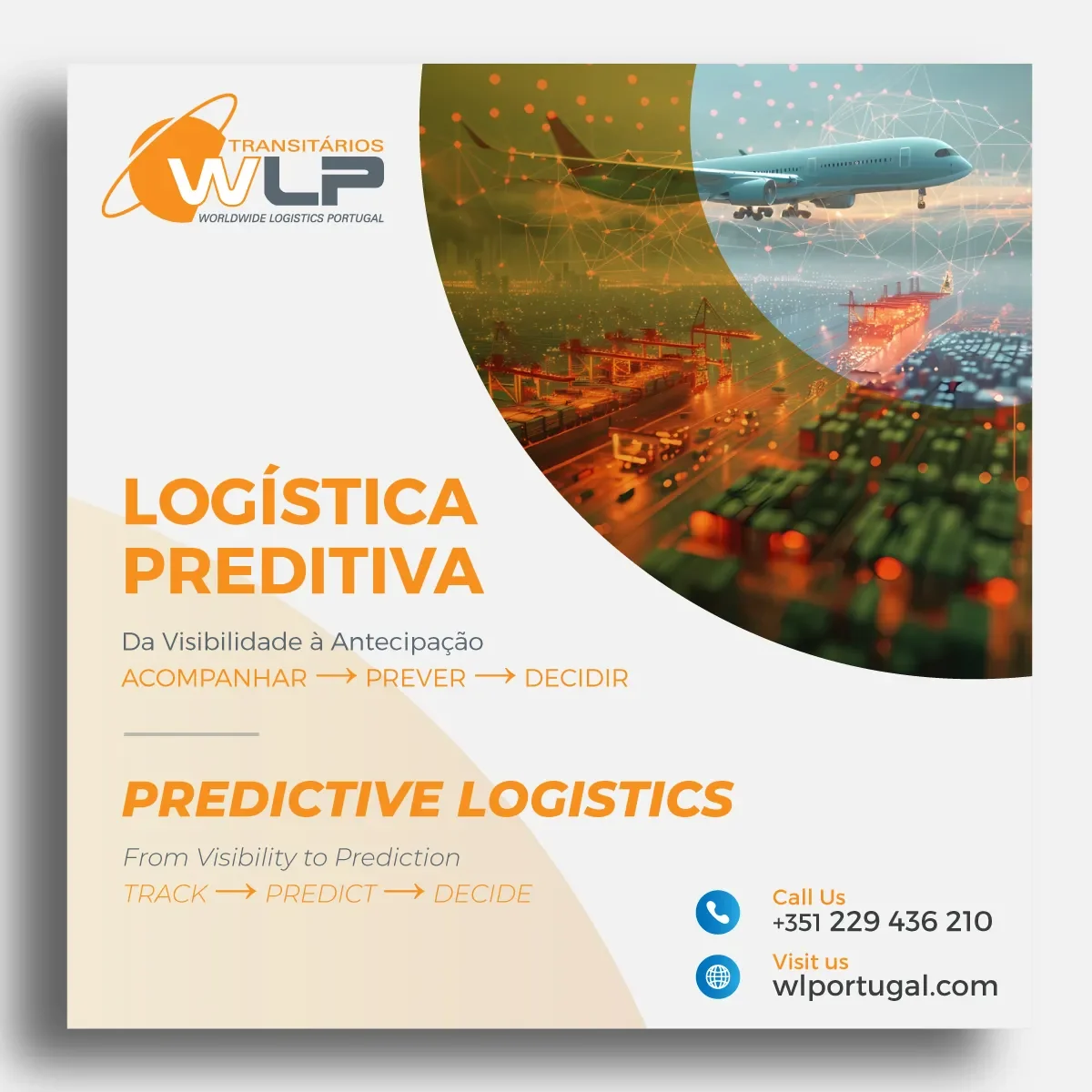
From Tracking to Predictive Logistics: How Artificial Intelligence Is Changing the Supply Chain
Knowing where your goods are is important. Anticipating what might happen next can make all the difference.
For many years, one of the main priorities in logistics was being able to answer a seemingly simple question:
Where are my goods?
The evolution of digital platforms, tracking systems and data integration has brought a level of visibility that would have been difficult to imagine just a few decades ago.
Today, however, knowing where a shipment is located is only part of the challenge.
In a world shaped by global supply chains, congestion, route changes, weather events, geopolitical instability and constant fluctuations in demand, companies increasingly need to answer a second question:
What might happen next?
This is where predictive logistics comes into play.
The combination of data, Artificial Intelligence (AI), Machine Learning and predictive analytics is progressively enabling logistics to evolve from an essentially reactive model towards an approach with a greater capacity for anticipation.
It is not about predicting the future with absolute certainty.
It is about using available information to identify patterns, calculate probabilities, anticipate risks and create more time to make better decisions.
From tracking to true visibility
Tracking represented a major step forward in logistics management.
Knowing the location of a shipment, monitoring different stages of transportation and receiving updates on the status of an operation have brought greater transparency to supply chains.
But location is not the same as visibility.
A company may know exactly where a container is and still be unaware that there is a high probability of the goods arriving late at their destination.
This distinction lies at the heart of the evolution towards Supply Chain Visibility.
True visibility results from combining different sources of information: location, schedules, transit times, port and airport data, weather conditions, congestion levels, operational history and other internal and external data.
When this information begins to be analysed together, we stop looking only at what is happening.
We begin to identify signals about what might happen next.
What is predictive logistics?
Predictive logistics uses historical data and real-time information to estimate future events and their probability.
In practice, systems can analyse thousands or millions of data points that would be extremely difficult to process manually at the same speed.
Through statistical models, algorithms and Machine Learning, it becomes possible to identify patterns and relationships between different events.
For example:
If certain ports are experiencing increasing congestion, weather conditions are deteriorating and similar operations have suffered delays under comparable circumstances, a system may identify an increased level of risk before the delay actually occurs.
The objective is not to eliminate uncertainty.
It is to reduce uncertainty and improve decision-making.
Where is Artificial Intelligence being applied?
The use of Artificial Intelligence in logistics is no longer limited to futuristic scenarios.
There are already several areas where advanced data analytics are contributing to more efficient supply chain management.
1. More dynamic Estimated Time of Arrival predictions
ETA — Estimated Time of Arrival — traditionally based on schedules and expected transit times can become much more dynamic when combined with real-time information.
Traffic, weather, congestion, previous port calls, port dwell times and historical route performance can all contribute to continuously recalculating expected arrival times.
This enables companies and operational teams to work with information that may be more closely aligned with actual conditions.
2. Early risk identification
One of the main benefits of predictive analytics is the ability to detect risk signals before a problem materialises.
A route beginning to experience congestion.
A port where average waiting times are increasing.
A connection with a higher probability of failure.
A region affected by adverse weather conditions.
Individually, each piece of information may appear relatively insignificant.
Analysed together, they may reveal a pattern that justifies preventive action.
3. Route optimisation
The route that appears to be the fastest or most economical at the time of booking may not remain so throughout the operation.
By integrating historical and real-time information, intelligent systems can help evaluate alternatives and identify potential constraints.
In certain circumstances, this may make it possible to change a decision before a problem becomes unavoidable.
4. Demand forecasting
AI is also transforming processes that take place before transportation begins.
Historical sales data, seasonality, market trends, consumer behaviour and other variables can be used to improve demand forecasts.
The better a company can anticipate what it will need, the better it can plan purchasing, production, inventory and transportation.
5. Inventory management and optimisation
More accurate forecasts can help companies find the right balance between two common challenges: excess inventory and stockouts.
Excess inventory ties up capital, increases storage costs and creates a greater risk of obsolescence.
Stockouts can result in lost sales, production disruptions and dissatisfied customers.
Predictive analytics can support decisions about when to order, how much to order and where particular inventory should be positioned.
6. Predictive maintenance
In transportation and logistics, equipment availability is essential.
Analysing data generated by vehicles, machinery and other equipment can help identify abnormal behaviour or signs of wear before a breakdown occurs.
Maintenance can therefore move beyond fixed schedules or reacting to failures and become progressively more aligned with the actual condition of equipment.
From predicting to recommending: the next step
There is another particularly interesting stage in this evolution.
If predictive logistics seeks to answer:
“What is likely to happen?”
so-called prescriptive logistics goes one step further:
“Given what is likely to happen, what could be the best course of action?”
Imagine an operation where there is a high probability of delay.
A system may not only identify that risk but also analyse alternatives: another route, another port, a different mode of transport, a change in priorities or the anticipation of certain operations.
Technology then moves beyond simply presenting information and becomes a decision-support tool.
More data does not necessarily mean better decisions
There is, however, one fundamental condition.
Artificial Intelligence depends on the quality of the data it receives.
Incomplete, outdated, fragmented or inaccurate information can lead to unreliable predictions.
This remains one of the major challenges in the digital transformation of supply chains.
An international operation may involve manufacturers, suppliers, freight forwarders, shipping lines, airlines, road hauliers, terminals, customs authorities, technology platforms and customers.
Each participant may generate information through different systems.
Integrating this data, ensuring its quality and transforming it into coherent information remains one of the main challenges in achieving true Supply Chain Visibility.
Before predictive intelligence can exist, there must be high-quality information.
Artificial Intelligence does not eliminate human expertise
There is another misconception worth addressing: the idea that AI will automatically replace human decision-making in logistics.
A supply chain does not operate on data alone.
Commercial relationships, market knowledge, operational experience, negotiation, context and countless exceptional situations cannot always be fully represented by an algorithm.
Technology may identify a high probability that a particular operation will be delayed.
But deciding whether that risk justifies changing a route, accepting an additional cost or choosing another mode of transport still requires context.
The greatest transformation, therefore, is unlikely to come from replacing people with Artificial Intelligence.
It will come from putting better information in the hands of experienced professionals.
From reactive logistics to anticipatory logistics
For decades, much of logistics management was necessarily reactive.
A problem occurs.
The team identifies it.
Alternatives are analysed.
A solution is found.
The growing availability of data and predictive tools is beginning to change this sequence.
The objective is to identify signals before the problem occurs.
Data → Analysis → Prediction → Decision → Action
The earlier an organisation identifies a risk, the greater the number of alternatives it is likely to have available.
And this difference can be decisive.
Once a delay has already occurred, the available options may be limited and expensive.
When there is an early enough indication that a delay may occur, there may still be time to adapt the plan.
This is where predictive logistics demonstrates its real value.
Not simply predicting. Creating time to decide.
Is your Supply Chain ready?
The transition towards more predictive logistics does not happen overnight.
Nor does it necessarily begin with a major Artificial Intelligence project.
It starts with a number of fundamental questions:
- Can the company consistently monitor its operations?
- Is data scattered across different systems or properly integrated?
- Is there sufficient historical information to identify patterns?
- Have the main supply chain risks been identified?
- Does the organisation receive information early enough to act?
- Are decisions mainly taken after problems occur, or is there already some capacity for anticipation?
These questions help determine the maturity level of a Supply Chain.
Because before you can predict, you need to see.
And before decisions can be automated, the underlying processes need to be understood.
The future will not simply be about knowing where your goods are
The evolution from tracking to Supply Chain Visibility represented a fundamental step in the digitalisation of logistics.
Predictive logistics represents the next step.
It does not mean eliminating delays, disruptions or unexpected events.
A global supply chain will always be exposed to variables that cannot be fully controlled.
What changes is the ability to anticipate some of these situations and gain time to respond.
Artificial Intelligence, Machine Learning and advanced data analytics will become increasingly important in this process.
But technology alone is not enough.
High-quality data, business knowledge, logistics expertise and decision-making capabilities will remain fundamental.
The future of logistics will not simply be about knowing where your goods are.
It will be about understanding what is likely to happen next — and having the time to make a better decision.
From information to anticipation: prepare your Supply Chain for the next step
The digital transformation of logistics does not necessarily begin with the implementation of Artificial Intelligence.
It begins by understanding what information is available, how it is used and whether it reaches the right people in time to support a decision.
Improving visibility, identifying critical points, assessing risks and selecting solutions suited to each operation are fundamental steps towards building a progressively more efficient, resilient and anticipatory supply chain.
At WLP, we combine international logistics expertise with an integrated understanding of each business’s requirements, helping companies find transportation and Supply Chain solutions suited to their specific challenges.
Would you like to understand how to make your supply chain more visible, efficient and better prepared to respond to change?
Talk to our team.
WLP – Worldwide Logistics Portugal
Connecting Businesses Worldwide.
Frequently Asked Questions about Artificial Intelligence and Predictive Logistics
What is predictive logistics?
Predictive logistics uses historical data and current information to estimate future events, identify patterns and anticipate potential risks or changes within a supply chain.
The objective is not to predict the future with absolute certainty, but to increase the capacity for anticipation and support more informed decisions.
What is the difference between tracking, Supply Chain Visibility and predictive logistics?
Tracking makes it possible to monitor the location and status of a particular shipment.
Supply Chain Visibility aims to provide a broader view of the operation by integrating information from different stakeholders, processes and systems.
Predictive logistics adds another dimension: it uses this data to estimate what may happen next and identify potential risks or deviations in advance.
How is Artificial Intelligence used in logistics?
Artificial Intelligence can be applied to areas such as Estimated Time of Arrival predictions, detection of potential delays, route optimisation, demand forecasting, inventory management, predictive maintenance and risk analysis.
Its effectiveness, however, depends on the quality, quantity and relevance of the available data.
Can Artificial Intelligence predict transport delays?
AI can help estimate the probability of delays by analysing different variables together, including operational history, congestion, weather conditions, route performance and dwell times at ports and terminals.
This does not mean that every delay can be predicted, but it can enable certain risk situations to be identified earlier.
Is predictive logistics only relevant for large companies?
Not necessarily.
The level of technology and integration required will depend on the size and complexity of the supply chain, but companies of different sizes can benefit from better information, greater visibility and more structured decision-making processes.
The evolution can be gradual, beginning with improvements in the quality and integration of existing data.
Will Artificial Intelligence replace logistics professionals?
The most likely development is greater complementarity between technology and human expertise.
AI can process large volumes of information, identify patterns and support predictions. Logistics decisions, however, often involve commercial context, negotiation, operational experience and the assessment of exceptional situations.
Its greatest potential therefore lies in using technology to put better information in the hands of the people responsible for making decisions.
What is prescriptive logistics?
While predictive logistics seeks to answer “What is likely to happen?”, prescriptive logistics seeks to answer “Given this scenario, what could be the best course of action?”
It therefore represents an evolution from data analysis towards systems capable of supporting the evaluation and recommendation of different alternatives.
How can a company start preparing for predictive logistics?
The first step is to assess the quality and availability of existing data.
It is important to understand what information is collected, where it is stored, whether different systems can communicate with one another and whether the organisation has sufficient visibility over its processes.
Before you can predict, you need to see.
A solid foundation of Supply Chain Visibility is therefore one of the main starting points for a predictive logistics strategy.


